How to Be Present With Your Family on Ordinary Days

Parent driving a daughter to practice at golden hour, an ordinary family moment. Leading on the Forward Edge At Home.

Leading on the Forward Edge – At Home · Character Creates Opportunity® · Reflection: “The Last Ordinary Day”

Key takeaways

  • Name a good moment out loud while you are in it, with one simple sentence.
  • Give ordinary moments five extra minutes, because the real conversation usually shows up around minute five.
  • Do the ordinary thing badly rather than skip it; the burnt dinner and distracted drive still count.

Let's face it, most of us are quietly waiting for the important days.

The graduation. The wedding. The championship game. The holiday when everyone finally makes it home at the same time. We circle those on the calendar and tell ourselves that is when life will really be happening.

Which means we treat everything in between as rehearsal.

The Tuesday drive to practice with the radio turned down low. The dinner that came out burnt and got eaten anyway. The argument about homework that neither of us handled well. The grocery run, the folded laundry, the twenty quiet minutes on the couch before somebody's phone went off.

Ordinary days. Warm-up laps before the real race.

I have lived enough of them by now to know better, and I still catch myself doing it.

Here is what shows up later, usually when we are not ready for it. There is a last ordinary day in every season of a family's life. A last day of carrying a child on our shoulders. A last day of a house with everybody under one roof. A last ordinary conversation with a parent while they are still fully themselves.

None of those days announce themselves. Nobody hands us a program or blows a whistle. We do the drive, eat the dinner, lose the argument, go to bed — and then one day we look up and that season is over.

The days we would pay almost anything to have back are rarely the big occasions. They are the Tuesdays.

It works the same way outside our homes. The workplace has its last ordinary day too, the last afternoon a particular team is together before the reorganization we did not see coming. So does our community, the last season we coached, the last year we sat in the same row beside the same people.

We only ever recognize those days looking backward.

We cannot force ourselves to feel the weight of an ordinary day while we are inside it. But we can change how we handle one. Here are a few steps that have helped me over the years:

  1. Name it out loud while we are standing in it. This feels awkward the first time and it is worth doing anyway. In the car on the way home, or at the table when the plates are still out, say some version of "this is a good one." Not a speech, not a post on social media, just a simple sentence. Naming a moment while we are standing in it is how we stop filing it under rehearsal, and it teaches everyone at the table to notice their own life while they are living it.
  2. Give the ordinary moment five extra minutes. The pull is always toward the next thing on the list, and the next thing will still be there. Stay at the table five minutes after the plates are cleared. Sit on the edge of the bed five minutes longer than the goodnight required. Almost nothing important in my life has ever been said in the first minute of a conversation. The real thing shows up somewhere around minute five, and only if we are still sitting there.
  3. Do the ordinary thing badly rather than skip it. We tell ourselves we will show up when we can do it right…when work settles down, when we are less tired, when we can be the version of ourselves we had in mind. That day does not arrive. The burnt dinner still counted. The distracted drive to practice still counted. Pick the one ordinary thing this week we have been quietly outsourcing or postponing, and do it ourselves at whatever grade we can manage on a Tuesday.

I am not writing this from higher ground. I have missed plenty of ordinary days while I was busy preparing for important ones, and I have learned that the bill for that comes due quietly, years later.

None of this requires a change in our circumstances. It only requires deciding that today is not a warm-up.

As we treat our ordinary days as the real thing, we will build and strengthen our character, and Character Creates Opportunity to be fully present with those we care about most, while we still have the day in front of us.

If I were to ask you, "What is holding you back today from being your best for those you care about most?" what would you say?

Please reach out if I can help you today. My mobile is 269-370-9275 and my email is david@harvesttimepartners.com

Please download some FREE resources at www.harvesttimepartners.com I hope you will find them helpful in your journey to be your best for those you care about most.

This reflection builds on two earlier Character Creates Opportunity® posts: Before It Is Too Late and When We Were Young.

Questions this reflection answers

How can I be more present with my family on ordinary days?

Treat ordinary days as the real thing, not rehearsal. Name a good moment out loud while you are in it, stay five extra minutes at the table or bedside, and do the everyday things yourself even when you cannot do them perfectly. None of this needs a change in circumstances, only a decision that today is not a warm-up.

Why do ordinary family moments matter so much?

Every season of family life has a last ordinary day, like the last time you carry a child on your shoulders, and none of them announce themselves. We only recognize them looking backward. The days people most want back are rarely graduations or weddings. They are the regular Tuesdays spent together.

How to Get Your Kids to Talk to You Beyond “Fine”

Parent leaning on the kitchen counter listening to a teenager after school. Leading on the Forward Edge At Home.

Leading on the Forward Edge – At Home · Character Creates Opportunity® · Reflection: “The Second Question”

Key takeaways

  • Do not accept "fine" and move on; ask a second question right when it would be easy to stop.
  • Try "What was the hardest part?", "Who did you sit with?", or "Do you want help, or should I just listen?"
  • After you ask, stay quiet and let the silence do the asking instead of filling it.

How many times this week did we ask someone in our house, "How was your day?"

And how many times did we take "Fine" and move right along?

I have done it more times than I would like to admit. The question gets asked from the hallway, or over a shoulder while the dishwasher is being loaded, or from the front seat with the turn signal already on. The answer comes back in one word. And if we are honest, both people are a little relieved.

We asked. They answered. Nothing happened.

Here is what I have come to believe after a lot of years of getting this wrong. The first question is a formality. It is a knock on the door. The entire relationship lives in the second question — the one we ask after the first answer lands, at the exact moment when it would be completely acceptable to stop.

"Fine" is not information. It is a test.

So why do we stop at one? Three honest reasons, and I have used all of them.

We are tired. By the time we walk in the door, we have already spent the day being patient with people who are paid to be in the room with us, and the tank is low.

We are afraid of the answer. Somewhere underneath, we suspect the real answer might be something we cannot fix, or something about us.

And we are already halfway to the next thing. The mind is on the email, the bill, the early meeting. The body is in the kitchen. The person in front of us can tell the difference instantly.

This is not only a home problem. We do it in the workplace when we ask a teammate how the project is going and accept "we're good." We do it in our community when we ask a neighbor on an evening walk or another parent on the sideline how they are holding up and let "hanging in there" close the subject. But the cost is highest at home, because at home the people are not going to file a report. They will simply stop offering.

A few second questions that have worked in my house, on the nights I remembered to ask them:

  1. "What was the hardest part?" This one does more work than any other question I know. It skips right past the highlight reel and gives the hard part somewhere to go. It also carries a quiet assumption inside it…that there was a hard part, and that hearing about it will not cost them anything. Ask it, then say nothing. The first answer will be a shrug. The second answer, thirty or forty seconds later, is the one worth waiting for.
  2. "Who did you sit with?" Specifics unlock people in a way that general questions never will. "How was school" is a survey; "who did you sit with at lunch" is a conversation, and it works just as well on a spouse who came home from a rough week. Pick one small, concrete corner of their day and ask about that corner only. Details give a tired person something to hold onto when they do not have the energy to summarize.
  3. "Do you want help with this, or do you want me to just listen?" I got this one wrong for years, mostly by charging in with solutions nobody requested. Asking the question directly does two things. It tells them we are actually available, and it hands them the controls. Then we honor whichever answer they pick, including the one that leaves the problem unsolved on the table between us.

None of these work without the part nobody wants to hear about, which is sitting still.

The second question buys us about ten seconds of silence, and ten seconds feels like a very long time. Our instinct is to fill it — with advice, with a story about ourselves, with a glance at the phone. Do not fill it. Stay in the chair, stay in the conversation, and let the quiet do the asking for us. The important things in our homes almost never get said on demand. They get said sideways, late, and only to someone who is still sitting there.

As we ask the second question and stay quiet long enough to hear the answer, we will build and strengthen our character, and Character Creates Opportunity to know what is actually going on in the lives of those we care about most.

If I were to ask you, "What is holding you back today from being your best for those you care about most?" what would you say?

Please reach out if I can help you today. My mobile is 269-370-9275 and my email is david@harvesttimepartners.com

Please download some FREE resources at www.harvesttimepartners.com I hope you will find them helpful in your journey to be your best for those you care about most.

This reflection builds on two earlier Character Creates Opportunity® posts: It is Your Turn to Ask and A Helpful Question.

Questions this reflection answers

What should I ask my kids instead of "How was your day?"

Ask a second question after the first answer. "What was the hardest part?" gives the hard part somewhere to go. "Who did you sit with?" works because specific questions are easier to answer than general ones. "Do you want help with this, or do you want me to just listen?" lets them choose what they need from you.

Why do family members stop sharing with us?

Often we stop at one question because we are tired, afraid of the answer, or already thinking about the next thing, and people can tell. At home, people will not file a report. They simply stop offering. The important things usually get said sideways and late, only to someone who is still sitting there.

How to Encourage Your Adult Children (and Aging Parents)

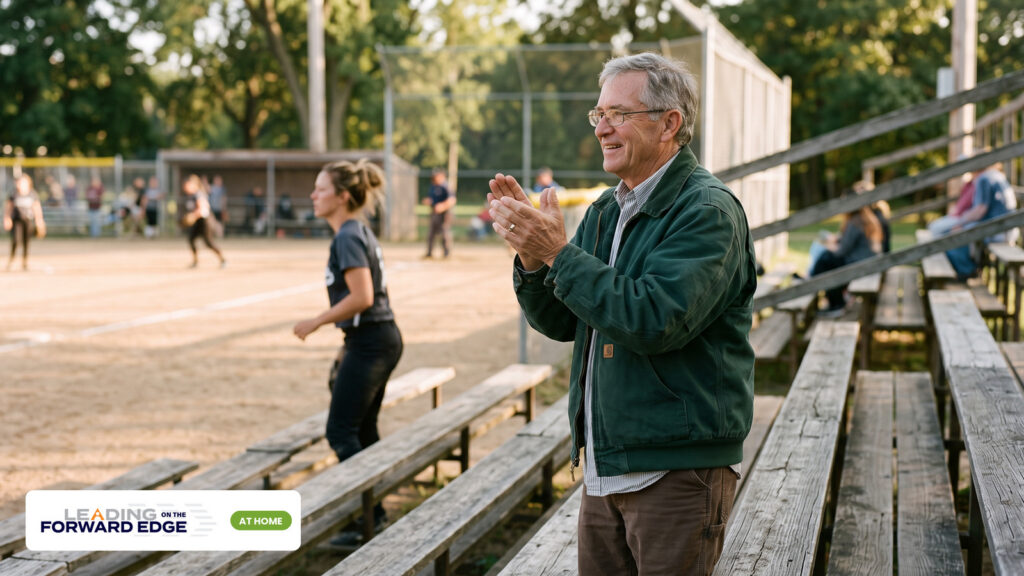
Older father standing and clapping in the bleachers for his grown daughter. Leading on the Forward Edge At Home.

Leading on the Forward Edge – At Home · Character Creates Opportunity® · Reflection: “Cheering from the Bleachers, Twenty Years Later”

Key takeaways

  • Text a grown child or sibling about one trait of their character, not their results, with no advice attached.
  • Call a parent this week and tell them a specific sacrifice of theirs you remember.
  • Say something specific you admire about your spouse out loud, in front of someone else.

A while back I wrote about cheering from the bleachers. That memory most of us carry of hearing someone yell our name across a field when we were eleven years old, and how much energy it gave us to keep going.

Here is the part I did not write.

The kids we cheered for are adults now. They are still playing. The games just moved.

They are playing on fields we cannot see and were never issued tickets to. A hard quarter at work where the numbers are not going to come in. A marriage going through a stretch nobody outside the house knows about. A diagnosis they have not mentioned to anyone, because mentioning it would make it real.

And here is the difference that ought to bother us. When they were eleven, there was a schedule on the refrigerator. Somebody knew where the game was, and the bleachers were full.

Now there is no schedule. Nobody knows where the field is. And most of the time, those bleachers are completely empty.

The same is true of our aging parents, who are quietly playing the hardest season of their lives while telling us everything is fine. It is true of a spouse who has been carrying something for months and stopped expecting anyone to notice. It shows up in the workplace, where the most competent person on the team is often the last one anyone thinks to encourage, and in our community, where we assume the family that always seems to be doing well must be doing well.

Grown people do not ask for encouragement. That is exactly why it is so needed.

We do not need to know what the game is in order to sit in the stands. Below are a few ways to get back in the bleachers and help share a boost of encouragement, just like the old days:

  1. Cheer for who they are, not for what they pulled off. With small kids, encouragement was easy because there was a scoreboard. With adults, most of the important effort happens where there is no score at all; the hard conversation they had with an employee, the way they keep showing up for a friend, the fact that they have not quit. Send a text this week to a grown child or a sibling that names one thing about their character, not their results. "I have watched you handle a hard year without getting bitter about it, and I do not think you know how rare that is." No advice attached. No question at the end that puts work back on them.
  2. Tell a parent the thing they are convinced we never noticed. Somewhere in our parents' minds is a running tally of the sacrifices nobody ever mentioned; the second job, the missed thing, the years of quiet worry. Most of them go to their grave assuming those went unseen. Pick one specific memory, the more ordinary the better, and tell them we remember it. Do it by phone rather than text, because they need to hear it in our voice, and do it this week rather than at the next holiday when there are twelve people in the room.
  3. Say the encouraging thing to our spouse out loud, in front of somebody else. After enough years, the appreciation goes silent. Not because it stopped, but because we assume it is already understood. It is not. Say the specific thing at the dinner table where the kids can hear it, or to a friend while our spouse is standing right there. Something we admire about how they are handling this particular season, not a general compliment. It is a small thing that costs us nothing and gets remembered for months.

I want to be careful here, because I have been on the wrong side of all three. There were stretches when I was so occupied with my own field that I did not think to wonder what game anybody else was playing. Encouragement is a habit, and habits can be started at any age.

Nobody is going to hand us a schedule. There will be no announcement that someone we love is having the worst month of their year. We just have to decide to be the kind of person who sends something anyway, for no occasion at all.

As we send some cheering from the bleachers to the grown people playing on fields we cannot see, we will build and strengthen our character, and Character Creates Opportunity to give those we care about most the energy to keep moving forward.

If I were to ask you, "What is holding you back today from being your best for those you care about most?" what would you say?

Please reach out if I can help you today. My mobile is 269-370-9275 and my email is

Please download some FREE resources at www.harvesttimepartners.com I hope you will find them helpful in your journey to be your best for those you care about most.

This reflection builds on an earlier Character Creates Opportunity® post: Cheering from the Bleachers.

Questions this reflection answers

How do I encourage my adult children?

Cheer for who they are, not what they achieved. Send a text that names one thing about their character, such as how they handled a hard year without getting bitter. Leave out advice and do not end with a question that puts work back on them. You do not need to know what they are facing to encourage them.

How can I show appreciation to my aging parents?

Pick one specific memory of a sacrifice they made, the more ordinary the better, and tell them you remember it. Do it by phone rather than text so they hear it in your voice, and do it this week instead of waiting for a holiday when the room is full of people.

Screen-Free Family Time: How to Turn Down the Noise

Family talking at the dinner table with their phones set aside. Leading on the Forward Edge At Home.

Leading on the Forward Edge – At Home · Character Creates Opportunity® · Reflection: “The Volume of Our Home”

Key takeaways

  • Pick one recurring hour, like dinner, and put everyone's phones in a basket, adults first.
  • Turn off one source of background noise nobody is using, like a TV playing to an empty room.
  • Sit in the car for sixty seconds before going inside, then walk in slowly and ask nothing right away.

Every home has a volume level.

Not the setting on the television. The overall level: the running total of screens, schedules, notifications, group texts, the game on in a room nobody is sitting in, and our own hurry moving down the hallway.

Most of us have never once sat down and decided what ours should be. It simply got set for us, a little louder each year, by whatever happened to be going on at the time.

That is worth stopping on for a minute. We make decisions about our homes all the time. We decide where the furniture goes and what is for dinner and which activities are worth the drive on a Wednesday night. The volume is the one setting almost nobody chooses on purpose, and it may be the setting that determines the most.

Because noise is not really about sound.

Noise is the absence of any margin in which a hard thing could get said.

Here is what I mean. The important things in a family almost never arrive on schedule and almost never arrive head-on. Nobody sits down at the kitchen table and announces that they are struggling. It comes out sideways like a comment from the back seat with fourteen minutes left in the drive, a half-sentence at the sink while the pan is being scrubbed, a text at 11:40 at night that says "you up?"

Every one of those requires a gap. A stretch of unfilled time in which somebody works up the nerve.

If there is no gap, the thing does not get said. It does not get resolved somewhere else, either. It just stays in.

We know this instinctively in other parts of life. The best conversations in the workplace happen in the ten minutes after the meeting ends, not during it. The most honest thing anyone says at a community gathering gets said in the parking lot. But at home, where it matters most, we run the volume high all evening and then wonder why nobody tells us anything.

I have been the loudest thing in my own house on plenty of ordinary evenings. I learned over the years that a few simple adjustments can help manage the volume in a more effective way:

  1. One hour (ok maybe just 30 minutes), one basket. Pick a single recurring hour, dinner most nights, or the drive, or the last hour before bed and make it a screen-free zone for everyone, adults very much included. Put a basket on the counter and let the phones live there for that hour. The rule only works if we go first and if we do not narrate how well we are doing at it. Expect the first several nights to feel strained and a little boring. That boredom is not a malfunction. That boredom is the gap.
  2. Turn off the noise nobody chose. Somewhere in most houses there is a television playing to an empty room, a speaker running a playlist nobody selected, a radio filling the car out of pure habit. None of it was decided; it accumulated. Walk through this week and shut off one source of background noise that no one is actually using, then leave it off. The silence in a car with the radio off is where a teenager finally says the thing. It is where a spouse finally says the thing too.
  3. Slow our own tempo. This is the hardest one, and it is the one I get wrong most. The volume of a home is set less by devices than by the pace of the adult who just walked in the door; the keys hitting the counter, the half-listening "uh huh," the body language that says we are already on to the next task. Before going inside tonight, sit in the car for sixty seconds and let the day end. Then walk in slowly and ask nothing of anyone before the coats are even off. Our family reads our tempo before they hear a word we say.

None of this requires a family meeting or a new set of house rules that nobody follows past the second week. It requires one hour, one switch, and sixty seconds in the driveway.

The quiet will feel uncomfortable at first, for us more than for them. Sit in it anyway. What we are building is not silence for its own sake. We are building the space in which somebody we love can finally say a hard thing.

As we turn down the volume in our homes, we will build and strengthen our character, and Character Creates Opportunity to hear what those we care about most have been trying to tell us.

If I were to ask you, "What is holding you back today from being your best for those you care about most?" what would you say?

Please reach out if I can help you today. My mobile is 269-370-9275 and my email is david@harvesttimepartners.com

Please download some FREE resources at www.harvesttimepartners.com I hope you will find them helpful in your journey to be your best for those you care about most.

This reflection builds on two earlier Character Creates Opportunity® posts: The Need to Get Quiet and A Risk in Our Virtual World.

Questions this reflection answers

How do I create more quiet time at home with my family?

Choose one recurring hour, such as dinner or the drive, and make it screen-free for everyone, with phones in a basket and adults going first. Turn off background noise nobody chose. Then slow your own pace when you get home. Expect the first nights to feel awkward. That boredom is the gap where real talk happens.

Why won't my teenager talk to me?

The important things in a family rarely come head-on. They come sideways, like a comment from the back seat or a late-night text. Each one needs a gap of unfilled time for someone to work up the nerve. If the house is loud all evening, the thing does not get said. It just stays in.

Modeling Behavior for Kids: They Learn What They See

Child watching a parent help an elderly neighbor carry groceries. Leading on the Forward Edge At Home.

Leading on the Forward Edge – At Home · Character Creates Opportunity® · Reflection: “What They See Us Do”

Key takeaways

  • Treat people who can do nothing for you with real kindness, and do not point it out afterward.
  • Name the difficulty without tearing apart people who are not in the room.
  • After snapping at someone, go back within the hour and say plainly, "That was on me, I am sorry."

We spend a great deal of energy on what we say to our families.

The talk in the car about effort. The line at dinner about being kind to people. The speech we have half-rehearsed about respect, or money, or screens, or what it means to keep our word.

None of that is wasted. It is just not where the learning happens.

Our families do not learn from our speeches. They learn from our patterns.

They learn from how we speak to the server who got the order wrong. From what we do with our phone the second it lights up at the table. From how we talk about our boss during the drive home, when we assume the back seat is not paying attention. From whether we ever say plainly that we were wrong about something.

We are teaching all day, whether we mean to or not. The curriculum is not the talk. The curriculum is the pattern.

This is uncomfortable, and it should be. I would much rather be evaluated on my intentions than on my patterns, because my intentions have always been excellent. My patterns have been a mixed bag…to say it kindly.

The pattern does not stop at the front door. In the workplace, a team learns what actually matters by watching what the leader tolerates, not by reading the values on the wall. In our community, people decide what we believe based on how we behave in a parking lot, not on what we say in a meeting. At home, the audience is smaller, closer, and paying far more attention than we would like.

The good news is that our patterns can be audited. Below are a few to think about this week:

  1. How we treat people who can do nothing for us. The server, the person on the other end of the customer service line, the driver who just cut us off, the neighbor we find tiresome. Our kids are running a quiet experiment on us in these moments, testing whether kindness is a value or a strategy. Pick one of these encounters this week and slow it down on purpose; get the person's name, say thank you like we mean it, let the merge happen. Then say nothing about it afterward. The lesson only lands if it looks like who we are rather than a demonstration.
  2. What we say about people who are not in the room. The drive home is where a lot of families quietly learn how loyalty works. If our boss, our in-laws, and our neighbors all get taken apart in the car, we are teaching a very clear rule: this is what we do with people when they cannot hear us. And every person in that car is smart enough to know the rule applies to them too. This week, when the complaint is right there and fully justified, try naming the difficulty without taking apart the person. "That was a hard week and I did not agree with the call" teaches something entirely different than the version we would rather say.
  3. What we do after we are wrong. This is the pattern that matters most and gets practiced least. Most of us grew up watching adults handle being wrong by going quiet, getting busy, or being unusually nice the next morning without ever naming what happened. That is a pattern too, and our kids inherit it. The next time we snap at somebody in our house, and there will be a next time, go back within the hour and say the plain version: "I was short with you earlier, that was on me, I am sorry." No explanation of what they did to provoke it. That sentence, repeated over years, teaches a child that being wrong is survivable, which is one of the most useful things a person can know.

I am not writing any of this from a position of strength. My family has watched me do all three of these badly, sometimes in the same week…sometimes in the same day. What I have learned is that they are far more forgiving of the failure than we expect, and far more attentive to the repair than we realize.

We do not get to choose whether we are teaching. That part is already settled. We only get to choose what the lesson is.

As we pay honest attention to the patterns our families are actually watching, we will build and strengthen our character, and Character Creates Opportunity to leave those we care about most with something better than good intentions.

If I were to ask you, "What is holding you back today from being your best for those you care about most?" what would you say?

Please reach out if I can help you today. My mobile is 269-370-9275 and my email is david@harvesttimepartners.com

Please download some FREE resources at www.harvesttimepartners.com I hope you will find them helpful in your journey to be your best for those you care about most.

This reflection builds on two earlier Character Creates Opportunity® posts: Patterns and A Pathway to Positive Influence.

Questions this reflection answers

How do children learn values from their parents?

Children learn far more from patterns than from speeches. They watch how you treat a server who got the order wrong, what you do when your phone lights up at dinner, how you talk about your boss on the drive home, and whether you ever admit you were wrong. The lesson is the pattern, not the talk.

How should I apologize to my child after losing my temper?

Go back within the hour and say the plain version: "I was short with you earlier, that was on me, I am sorry." Do not explain what they did to provoke it. Repeated over years, that sentence teaches a child that being wrong is survivable, which is one of the most useful things a person can know.

How to Apologize to Your Child and Repair After Conflict

Mother kneeling on the stairs to apologize to her daughter after an argument. Leading on the Forward Edge At Home.

Leading on the Forward Edge – At Home · Character Creates Opportunity® · Reflection: “The Repair”

Key takeaways

  • Name the hard moment plainly within a day, for example, "I want to talk about last night."
  • Own your part with no "but," then stop talking.
  • Ask what it cost the other person, listen to the end without defending, and say "Thank you for telling me."

Every home has hard moments.

The raised voice at the end of a long day. The door closed a little too hard. The comment made in the kitchen that we cannot unsay, and that hangs in the air long after everyone has gone to bed.

Most of us grew up believing that the healthy families were the ones where this did not happen. That has not been my experience.

Hard moments happen everywhere people are close. They happen in the workplace when we snap at a colleague in front of the team. They happen in our community when a hard word flies at a ballgame or a school board meeting. And they happen at home most of all, because home is where our guard is lowest and the stakes are highest.

What separates the healthy homes from the struggling ones is not that the hard moments never happen. It is whether anybody goes back.

Most of us were never taught how to go back. We were taught to wait until it blows over. Give it a day, come down for breakfast, pass the cereal, talk about the weather, and let time do the quiet work of forgetting.

Time does not do that work. Waiting teaches our children that damage is permanent and unspeakable, and that the way to handle a wound is to walk past it every morning for the rest of our lives.

I have waited things out in my own home, and I am not proud of it. It is easier in the moment. It is also the reason a few conversations in my life took years longer than they ever needed to.

The waiting is not really cowardice. It is usually a mix of pride, fatigue, and a quiet hope that if nobody mentions it, it did not count. But it counted. They just watch to see whether we are the kind of family that says so.

Repair is a skill, and any skill can be learned late. The three steps below can help make a repair real:

  1. Name it plainly. The repair starts with a sentence that does not hide. "I want to talk about last night" works; "everything okay?" does not, and neither does a joke in the doorway to test the temperature. A vague opening puts the burden on the other person to decide whether we are safe to talk to, and right after a hard moment they do not have the energy for that. Pick the moment; a car ride, the walk out to the mailbox, the quiet before lights out, and say the plain sentence within a day, while it still costs us something.
  2. Own our part without the word "but." Almost every apology I have offered in my life has had a "but" hiding somewhere in it, and that one word erases everything in front of it. "I am sorry I raised my voice, but you were not listening" is not an apology, it is a closing argument. Say the first half and then stop talking. The silence after a clean, unqualified apology is uncomfortable for a moment, and it is the most honest moment in the whole conversation.
  3. Ask what it cost the other person. This is the part most of us skip, because we have apologized and we would like the matter closed. "What was that like for you?" is a hard question to ask and a harder one to sit through. Do not defend, do not supply the context, do not correct the details of their memory. Listen all the way to the end and then say, "Thank you for telling me." We may not agree with a word of what we hear, and that is fine, because agreement was never the assignment. That answer is the actual repair; everything before it was only the setup.

None of this requires a perfect home. It requires a home where somebody is willing to walk back down the hallway.

Our children will not remember that we never lost our temper, because we will lose it. They will remember whether the person who lost it came back, and how long it took.

And they will do exactly what we modeled, thirty years from now, in a kitchen of their own.

As we go back and repair the hard moments in our homes, we will build and strengthen our character, and Character Creates Opportunity to give those we care about most a place where nothing is ever too broken to talk about.

If I were to ask you, "What is holding you back today from being your best for those you care about most?" what would you say?

Please reach out if I can help you today. My mobile is 269-370-9275 and my email is david@harvesttimepartners.com

Please download some FREE resources at www.harvesttimepartners.com I hope you will find them helpful in your journey to be your best for those you care about most.

This reflection builds on two earlier Character Creates Opportunity® posts: Gentleness and Addressing Resistance.

Questions this reflection answers

How do I repair my relationship with my child after an argument?

Go back instead of waiting it out. Within a day, open with a plain sentence like "I want to talk about last night." Apologize for your part without adding "but." Then ask, "What was that like for you?" and listen to the end without defending yourself. That answer is the actual repair.

Is it okay to just let a family argument blow over?

Waiting it out feels easier, but time does not do the work of repair. Waiting teaches children that damage is permanent and cannot be talked about. Children will not remember that you never lost your temper. They will remember whether the person who lost it came back, and how long it took.

How to Let Go of Expectations for Your Kids and Spouse

Parent letting go of a bike seat as a child rides away down the street. Leading on the Forward Edge At Home.

Leading on the Forward Edge – At Home · Character Creates Opportunity® · Reflection: “Holding Loosely at Home”

Key takeaways

  • Find one object that shows your grip on their outcome, like an old brochure, and put it in a drawer.
  • Stop asking the timing question for a while, including the gentle check-ins.
  • Pick one job that belongs to someone else and go a full week without trying to improve it.

Have we ever found ourselves disappointed in someone who did not actually do anything wrong?

It happens at the kitchen table on plenty of ordinary evenings. A report card comes home, a career decision gets announced, a spouse handles a Saturday differently than we would have handled it, and something in us quietly goes flat.

Nothing bad happened. Somebody simply did not match the picture.

Most of us are carrying a picture. We drafted it years ago, we have revised it a few times since, and we have never once shown it to the person it is about.

That is the strange cruelty of a tight grip. We hold an expectation so firmly that the actual person standing in front of us starts to register as a disappointment, measured against a version of them that exists nowhere except inside our own head.

And they never agreed to it. They were never handed the standard, never asked whether it fit, never given a chance to negotiate the terms. They just live underneath it and feel the weather change in the room when they fall short of something nobody ever told them about.

I have done this. I have caught myself grading people I love against a rubric I wrote alone, and then wondering why the room felt heavy.

The tighter the grip, the more the whole relationship gets measured by a standard the other person never had any part in setting. Over enough years, that measurement becomes the relationship.

Holding loosely is not lowering the bar and it is not caring less. In the workplace we call it giving a talented person room to find their own path. In our community we call it letting a neighbor be who they actually are. At home it is the same thing, and it is far harder, because at home we have convinced ourselves that the picture is love.

Holding loosely means loving the person we have instead of the one we drafted. Below are three tight grips worthy of a consideration to loosen:

  1. Our grip on the outcome. The sport, the school, the profession, the town they settle in; most of it we picked before they could talk. Some of it came from our own hopes and some of it came from our own regrets, and neither one is a good reason to hand somebody a life. There is usually physical evidence of the grip somewhere in our house like the brochure still on the counter, the jersey framed in the hallway, the sticker we bought a few years early. Find that one object this week and quietly put it in a drawer. A grip we can get our hands on is a grip we can open.
  2. Our grip on the timing. Very often we do not object to who somebody is becoming; we object to how long it is taking. Ready by twenty-two, settled by thirty, over it by Thursday; those are our watches, and nobody else in the house is wearing one. The action here is simple and it is hard: stop asking the timing question for a while. No "any word yet," no "have you given any more thought to," no gentle check-in that everybody at the table hears for exactly what it is.
  3. Our grip on the method. This grip shows up as running commentary on how a job got done; the dishwasher loaded wrong, the homework attacked in the wrong order, the money handled in a way we would not have handled it. If the outcome is fine, the method is not our business, and each small correction costs far more than it buys. Pick one job in the house that genuinely belongs to somebody else and go a full week without trying to improve it.

A looser grip does not mean we stop hoping for the people we love. It means our hope stops functioning as a bill they have to pay every time they walk in the room.

And something else happens that we do not expect. When the grip comes off, people tend to move toward us rather than away, because we are finally safe to be ordinary around.

The person at our table is not a rough draft of somebody better. They are the whole point.

As we hold the people in our homes a little more loosely, we will build and strengthen our character, and Character Creates Opportunity to give those we care about most the freedom to become who they actually are.

If I were to ask you, "What is holding you back today from being your best for those you care about most?" what would you say?

Please reach out if I can help you today. My mobile is 269-370-9275 and my email is david@harvesttimepartners.com

Please download some FREE resources at www.harvesttimepartners.com I hope you will find them helpful in your journey to be your best for those you care about most.

This reflection builds on two earlier Character Creates Opportunity® posts: Hold Loosely and Managing Expectations.

Questions this reflection answers

How do I stop being disappointed in my kids?

Notice the picture you have been carrying of who they should be. They never agreed to it or even saw it. Loosen your grip on the outcome you picked for them, on how fast they get there, and on how they do everyday jobs. Hope for them without making that hope a bill they have to pay.

Does holding loosely mean lowering my standards for my family?

No. Holding loosely is not lowering the bar or caring less. It means loving the person you have instead of the one you drafted. When the grip comes off, people tend to move toward you rather than away, because you are finally safe to be ordinary around.

How to Build Family Habits That Stick: Start Small

Parent and child watering a small seedling on a kitchen windowsill. Leading on the Forward Edge At Home.

Leading on the Forward Edge – At Home · Character Creates Opportunity® · Reflection: “The Small Step Nobody Notices”

Key takeaways

  • Make the step small enough to feel a little silly, like one question at dinner.
  • Attach the step to something that already happens, like the drive to school or the end of bedtime.
  • Do not announce the change; run it quietly until someone notices on their own.

We announce big changes at home with a certain amount of ceremony.

The new family schedule taped to the refrigerator. The screen-time policy explained at Sunday dinner. The once-a-week family meal everybody agrees to, with real sincerity, and means at the time.

Then it is the eleventh day. Somebody has practice, somebody is traveling, the paper on the refrigerator has a coffee ring on it, and nobody has looked at it in a week.

This is not a failure of will in our families. Big plans are not sustainable for any of us over the long haul, not in the home, not in the workplace, not in the community organizations we volunteer for. Big plans run on high energy, and energy is the one resource we cannot put on a calendar.

There is another reason the big plan fails, and it is less comfortable. A big announcement lets us feel like we have already done something. The taping of the paper to the refrigerator carries most of the emotional payoff, and once we have collected it, the work of the next eleven days has nothing left to run on.

Small incremental change builds momentum, and momentum is the thing that survives a hard month.

Here is the part that surprises people. The step that works is almost never the impressive one. The step small enough that it is a little embarrassing to say out loud is usually the one still alive in March.

I have announced my share of ambitious plans in my own house, some of them very well constructed. The ones that lasted were the quiet ones nobody clapped for.

Here are three small steps that compound at home:

  1. It should be small enough to feel silly. Not a family meeting, one question at dinner. Not a new communication culture in the house, one text before noon to whoever is having the hardest week. The test is simple: if we would feel a little foolish describing the step to a friend, it is probably the right size. A step that size survives travel, illness, bad moods, and the eleventh day, which is more than we can say for anything taped to a refrigerator. Small is not a compromise here; small is the whole mechanism.
  2. Bolt it to something that already happens. New habits fail because they need a new slot in a day that has no empty slots left in it. So do not build a slot. Attach the step to something that already happens without our help like the drive to school, the tail end of bedtime, the walk from the car to the front door. Pick the anchor first and the step second, and it will hold when the week goes sideways. The same principle carries in the workplace and in the community groups we serve: the practices that last are the ones bolted to a meeting or a routine that was already on the calendar.
  3. Do not announce it. Announcing a change turns it into a performance, and the moment we miss a day, everybody gets to watch us miss it. Run the step quietly for a while before we say one word about it. If somebody notices on their own, and eventually somebody does, that is worth more than any speech at Sunday dinner. Nobody in our house needs another plan from us; they have heard the plans. They need to notice that something has quietly been different for a while.

The reason small works is not that small is easy. It is that small is repeatable, and repetition is the only thing that has ever changed the temperature of a home.

One question at dinner, asked three hundred times over a year, is a different house. It is also nothing anybody would ever put on a refrigerator.

Eleven days from now, the plan on the refrigerator will be gone. The one question at dinner will still be there.

As we take the small steps nobody notices, we will build and strengthen our character, and Character Creates Opportunity to build a home for those we care about most that gets a little better every year instead of every January.

If I were to ask you, "What is holding you back today from being your best for those you care about most?" what would you say?

Please reach out if I can help you today. My mobile is 269-370-9275 and my email is david@harvesttimepartners.com

Please download some FREE resources at www.harvesttimepartners.com I hope you will find them helpful in your journey to be your best for those you care about most.

This reflection builds on two earlier Character Creates Opportunity® posts: Small Steps and A Quick Fix.

Questions this reflection answers

Why do our family plans and routines never stick?

Big plans run on high energy, and energy cannot be put on a calendar. Announcing a plan also gives us the good feeling of having already done something, so there is little left to carry the next eleven days. Small steps survive travel, illness, and bad moods because they are repeatable.

How do I start a new habit with my family?

Pick a step small enough that it feels a little foolish to describe, like one question at dinner. Attach it to something that already happens, such as the drive to school. Then do it quietly without announcing it. One question at dinner, asked three hundred times over a year, makes a different house.

How to Make Your Family Feel Valued With Quality Time

Father pulling out a chair at the family table for his teenage daughter. Leading on the Forward Edge At Home.

Leading on the Forward Edge – At Home · Character Creates Opportunity® · Reflection: “A Seat at Our Own Table”

Key takeaways

  • Give one person eight uninterrupted minutes with your phone in another room.
  • Catch a detail someone mentions, then ask about it by name two days later.
  • Tell someone the specific thing you do differently now because of something they said.

Why is it so much easier to make a stranger feel important than the people who live in our own house?

Underneath almost everything we do is one plain need: to know that we matter. It is there in a first grader holding up a drawing and it is there in a seventy-year-old telling the same story for the third time. It does not go away with age, income, or accomplishment.

We are usually pretty good at meeting that need out in the world. In the workplace we give the customer our full attention across the table and we ask the colleague about the surgery, the daughter, the move. In our community we remember the name of the man at the parts counter and we ask the woman at church how her mother is doing.

Then we walk through our own front door with whatever is left. Half a nod at the kitchen island. A question asked with our eyes still on a screen. The good energy is already spent, and the people who need it most end up with the leftovers.

That is the arithmetic of most homes, mine included. Not because we love our families less, but because we quietly assume they will still be there when we get around to them.

They will still be there. But "still there" and "still connected" are two different things, and the gap between them opens slowly enough that nobody notices it happening.

We would never treat a customer this way. We would never give a colleague eleven distracted seconds and consider the relationship handled. Somewhere along the line we started spending our professional discipline everywhere except the one room where it matters most.

The good news is that this need is not expensive to meet. It does not require a vacation, a project, or a better version of ourselves. It requires a few minutes of undivided attention, given on purpose.

Three ways to let somebody at our own table know they matter this week:

  1. Our undivided eight minutes. Attention is the currency here, and divided attention is counterfeit and everybody can tell, including the six-year-old. Put the phone in another room, not face down on the counter, and give one person in the house eight uninterrupted minutes. Eight is short enough that we will actually do it and long enough that the conversation gets past the first layer of "fine, how was yours." If the house is too busy, do it in the car, where a windshield makes the whole thing easier for most people, especially teenagers.
  2. The follow-up question. The most powerful sentence in any home is a specific one: "How did that thing with your friend turn out?" It tells someone we were listening the first time, which is what they will remember. This week, catch one detail somebody mentions in passing, write it on the back of a receipt if that is what it takes, and ask about it by name two days later. The detail itself matters far less than the proof that it stayed with us across two busy days.
  3. Tell them what we actually changed. People in our house have said things to us that stuck like a piece of advice we took, a correction that landed, a question we chewed on for a week. They almost never find out. Pick one person this week and name the specific thing we do differently now because of something they said to us months or years ago. Not "you were right," which costs us nothing, but "I stopped doing that because of what you told me in the kitchen last spring." Proof that somebody moved us is worth more than any compliment, and it lands better on an ordinary weeknight than at a milestone.

None of this takes a weekend away or a long conversation nobody has time for. It takes eight minutes, one question, and one piece of credit we have been sitting on for years without ever handing over.

The hard part is not the effort. The hard part is deciding that the people we come home to have first claim on the best of us rather than whatever survives the day.

As we give our own table the best of our attention instead of the leftovers, we will build and strengthen our character, and Character Creates Opportunity to let those we care about most know this week, and not someday, that they matter.

If I were to ask you, "What is holding you back today from being your best for those you care about most?" what would you say?

Please reach out if I can help you today. My mobile is 269-370-9275 and my email is david@harvesttimepartners.com

Please download some FREE resources at www.harvesttimepartners.com I hope you will find them helpful in your journey to be your best for those you care about most.

This reflection builds on two earlier Character Creates Opportunity® posts: A Holiday Connection and The Need to Know We Matter.

Questions this reflection answers

How can I make my family feel like they matter?

Give them undivided attention on purpose. Put your phone in another room and give one person eight uninterrupted minutes. Remember something they mentioned and ask about it two days later. Tell someone what you changed because of something they said to you. None of it takes a weekend away.

Why do I give my best energy to work and not my family?

Many of us give full attention to customers and colleagues, then walk in the door with whatever is left. It is not that we love our families less. We quietly assume they will still be there. They will, but "still there" and "still connected" are different, and the gap opens slowly.

How to Cope With Empty Nest Syndrome and Quiet Seasons

Couple having coffee at the kitchen table in a quiet house, a grown child's old bedroom behind them. Leading on the Forward Edge At Home.

Leading on the Forward Edge – At Home · Character Creates Opportunity® · Reflection: “When the House Gets Quiet”

Key takeaways

  • Let it be a loss; sit in the room that changed with nothing to accomplish.
  • Put something deliberate into one empty slot in your week, like a standing walk with a friend.
  • Send a no-agenda message to someone else whose house just went quiet.

The last car seat comes out of the back of the truck on an ordinary Tuesday afternoon, and nobody says a word about it.

Seasons at home end, and they almost always end exactly like that. No ceremony, no announcement, nobody standing up to mark the moment.

The last game gets played and we do not know at the time that it is the last one. A bedroom becomes an office. A parent moves in, or a parent moves on. The shoes by the front door go from a pile, to a pair, to none.

And then the house is quiet.

The quiet is not a problem to be solved. It is a transition, and most of us are unprepared for it because nobody warned us it was coming and nothing marked it when it arrived.

We handle transitions better everywhere else. In the workplace there is a last day, a card everybody signs, somebody carrying a box to the parking lot. In our community there is a retirement dinner, a plaque, a handshake in front of a room. At home, the largest transitions of our lives slide past on a Tuesday while the trash goes out.

I have sat in a quiet house and taken the quiet as evidence that something was wrong with me. It was not. It was a season ending without anybody ringing a bell.

And here is what nobody tells us: the quiet is not only an ending. It is the first honest look we have had at ourselves in a very long time, because the noise was doing a lot of work for us. In the quiet we finally hear what we actually want the next ten years to hold.

That is not a small gift, even if it arrives in a form we would not have chosen.

Here are three ways we can move through a quiet house well:

  1. Let it be a loss. We tend to talk ourselves out of this one. Other people have real problems, this is exactly what we raised them for, we ought to be grateful. All of that is true, and none of it changes the fact that something good is over. Go sit in the room that changed like the bedroom that became an office, the corner of the garage where the car seat used to go, and stay there a while with nothing to accomplish. Do not tidy it, do not carry anything out of it, do not put the time to use. Sitting in a room we have been walking past does more good than a month of pretending it is nothing, and gratitude and grief have always been able to sit at the same table.
  2. Rebuild the routine on purpose. The quiet is not really the problem; the empty shape of the day is. The 4:30 pickup, the Saturday field, the Sunday dinner for six, those were never just logistics, they were the scaffolding our whole week hung on. Pick one of those empty slots and put something into it deliberately this month: a standing walk with a friend, a class, a Saturday morning we drive somewhere for coffee. Do not wait until we feel like it, and in my experience the feeling tends to follow the routine rather than lead it. One anchored thing on the calendar changes an entire week.
  3. Somebody else is quiet tonight. On our street, in our office, in the row behind us at the ballgame, there is somebody whose house also went quiet, and they are assuming everyone else's is still full. One of the surest ways through our own quiet is to step into somebody else's. Send one message this week to a person we suspect is in a quiet house; no agenda, no advice, just "I was thinking about you today." That one message will do more for both houses than anything else on this list, and it costs us almost nothing.

Nobody rings the bell for us at home. So we ring it ourselves: we sit with what ended, we build the next season on purpose, and we go find the other people sitting in the quiet.

The season that ended was good. The next one is not written yet, and we still have a say in what goes in it.

As we move through the quiet seasons honestly and reach out to whoever else is in one tonight, we will build and strengthen our character, and Character Creates Opportunity to be steady and present for those we care about most in whatever the next season turns out to look like.

If I were to ask you, "What is holding you back today from being your best for those you care about most?" what would you say?

Please reach out if I can help you today. My mobile is 269-370-9275 and my email is david@harvesttimepartners.com

Please download some FREE resources at www.harvesttimepartners.com I hope you will find them helpful in your journey to be your best for those you care about most.

This reflection builds on two earlier Character Creates Opportunity® posts: The Bright Side of Loneliness and Transitions.

Questions this reflection answers

How do I cope when my kids move out and the house gets quiet?

Let it be a loss instead of talking yourself out of it; gratitude and grief can sit together. Rebuild one empty part of your week on purpose, like a standing walk or a class, without waiting to feel like it. Then reach out to someone else in a quiet house with a simple "I was thinking about you today."

Is it normal to feel sad when a season of family life ends?

Yes. The biggest transitions at home usually pass with no ceremony, so many people take the quiet as a sign something is wrong with them. It is not. It is a season ending without anyone ringing a bell. The quiet can also be the first honest look at yourself in a long time.